This is the step people skip, and it is the one that causes returns. A slide does not just add its own length to the footprint. Australian playground practice is to allow a clear fall zone around the whole structure, and at the bottom of a slide you need run out space beyond that, because a child leaving a slide is still moving.
The practical version: measure the assembled footprint on the listing, then add roughly 1.8m of clear space on every side, and more again straight off the end of the slide. Do that with a tape measure and some chalk in the actual yard before you order, not on a plan. Check what is in that zone too. A fence, a paved edge, a retaining wall or a garden bed with hard edging all count against you.
The other measurement worth taking is the swing beam height against anything overhanging, clotheslines and low branches especially. Every set in this range lists its assembled dimensions and its recommended clearance, and those two numbers together are what decide whether it fits.
The material argument changes once a slide is in the mix, because a slide needs a platform to come off, and platforms are where the two materials genuinely differ.
| Consider | Timber with slide | Metal with slide |
|---|---|---|
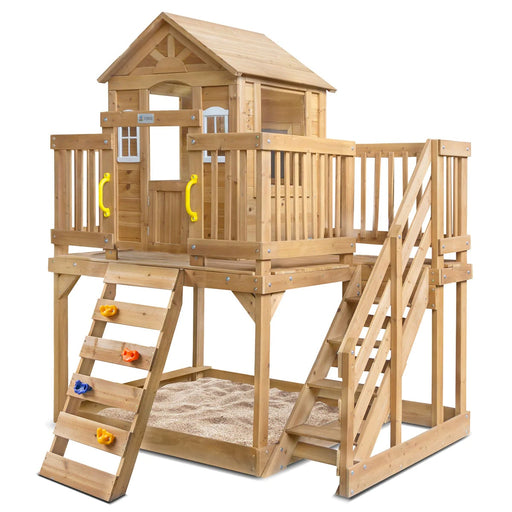
| Platform | Proper raised deck, often with a roof, rails and a ladder. Becomes a fort as well as a slide. | Usually a short moulded step up rather than a deck. The slide is an attachment, not a destination. |
| Footprint | Larger. The tower has to sit somewhere and the slide runs off it. | Tighter. A frame plus a short slide fits yards a timber play centre will not. |
| Assembly | A full day, sometimes two, and genuinely easier with two people. | Usually a few hours. Fewer parts, bolt together frames. |
| Moving it later | It stays where you build it. Treat it as permanent. | Can be shifted around the yard, and taken with you if you move house. |
| Upkeep | Annual check, re-oil or re-stain, watch the ground contact points. | Watch for rust at joints and where powder coat is chipped, especially near the coast. |
| Suits | A permanent backyard feature, more than one child, longer play sessions. | Smaller yards, tighter budgets, renters, or a first set. |
Neither is better. They are different purchases. If you want the full picture on each, the wooden swing sets and metal swing sets collections split the whole range by material.
Swing sets with slides sit in fairly clear bands in Australia, and knowing which band you are shopping in saves a lot of scrolling.
| Band | Typically | What you get |
|---|---|---|
| Entry | Around $400 to $700 | A frame with two or three swing stations and a short slide off one end. Metal, or a simple timber A frame. Fits a normal suburban yard. This is where most first sets land. |
| Mid | Around $700 to $1,400 | A raised platform, a longer slide, climbing wall or ladder, and usually a canopy. Timber becomes the norm here. The set starts being a destination rather than a swing. |
| Play centre | Around $1,400 to $2,600 | Tower with a roof, wave slide, multiple swing stations, monkey bars running off the back, sometimes a sandpit or lower cubby underneath. Needs real space and real assembly. |
| Commercial grade | $1,200 and up | Heavier steel, built for schools, childcare and parks rather than one family. Worth looking at if the set will take constant use. |
A note worth making, because nobody else will: the entry band moves fastest, particularly heading into spring. If the model you want is not showing, ask us rather than settling for the next one up, because we can usually tell you when it is due back.
Take the assembled footprint from the listing and add roughly 1.8m of clear space on every side, with extra run out straight off the end of the slide. Mark it out in the yard with chalk before you order. Fences, paving, retaining walls and hard garden edging all count as obstructions inside that zone.
Timber gives you a raised platform, so the slide comes off a deck and the set becomes a fort as well. Metal is tighter, cheaper, quicker to build and can be moved later. Timber for a permanent backyard feature, metal for smaller yards, tighter budgets or a first set.
Yes, all of them. Check whether anchors are included with the set you are looking at or sold separately. An unanchored set can lift under load, and anchoring is also usually a condition of the warranty.
Grass looks fine on day one and compacts to hard ground under the swings within a season. Softfall bark, rubber softfall or synthetic turf across the fall zone is the most worthwhile thing you can add after the set itself.
A metal frame with a slide is usually a few hours. A timber play centre with a tower is a full day and often two, and it is much easier with two people. We offer assembly in many areas, so ask us for a quote with your postcode before you order.
Broadly, Lifespan tends to give you more play stations for the money and leans towards timber play centres. Plum leans modular and climbing focused, with stronger options at the compact and metal end. We carry both, so you can compare them directly rather than taking either brand's word for it.
Yes. Traditional layby is available across this range, which suits a purchase at this price point. Our Price Match Guarantee compares the total delivered cost, product plus freight, which matters on large outdoor equipment where shipping is a real number.